欢迎来到 [东方港湾展览]
, 进入
2027宁波国际汽车零部件及售后市场展览会
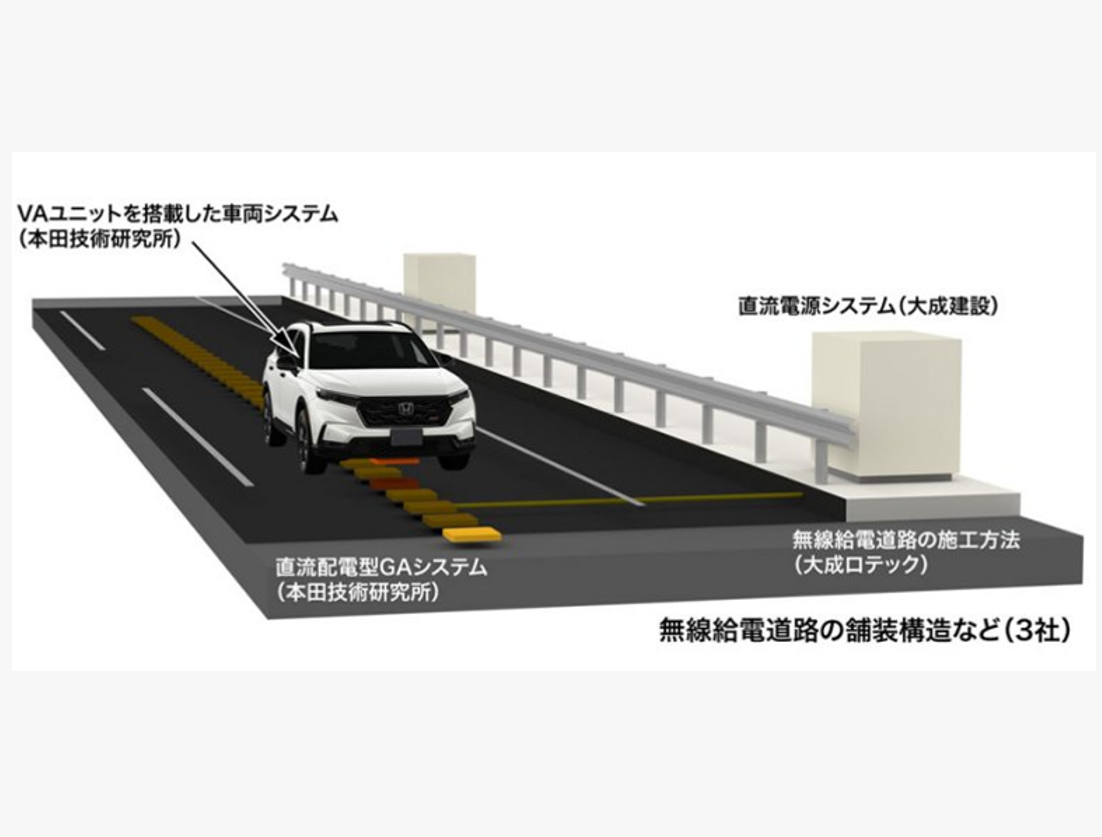
Charging time has long been a pain point for many electric vehicle (EV) owners. According to IT Home on October 5, Honda announced that its R&D subsidiary, Honda R&D Co., Ltd., has jointly developed the core technology for a magnetic-coupling wireless power supply road system with Taisei Corporation and Taisei Rotec. The system is designed to wirelessly charge electric vehicles while they are in motion, without requiring physical contact.
The three companies plan to begin full-scale testing on expressways in or after fiscal year 2027, which runs from April 1, 2026, to March 31, 2027. This means highway testing is expected to start in April 2027 or later.
According to the companies, the system combines the core strengths of all three partners: Honda's independently developed high-power-density power transmission and reception units that support DC power distribution, Taisei Corporation's high-response DC power supply system, and Taisei Rotec's established expertise in underground utility infrastructure and road-embedded installation technologies. The system is designed to deliver high-power charging while simplifying construction and installation, with potential applications across a wide range of vehicles, from passenger cars to heavy commercial vehicles.
Starting in late 2026, the three companies will build a dedicated test road at T-FIELD / TAMURA, Taisei Corporation's next-generation technology demonstration center in Tamura. Using real vehicles, they will conduct a cumulative total of one million wheel-load passes, equivalent to a standard single-wheel load of 49 kN, to evaluate the system's long-term durability. At the same time, they will test dynamic wireless power transfer while vehicles are moving and develop measures to prevent electromagnetic leakage. These efforts aim to balance efficient power delivery from road-embedded modules with the structural safety of underground road infrastructure.
Building on these tests, the team will validate the system's performance under high-power output conditions of up to 150 kW for heavy commercial vehicles. Further testing will also focus on system reliability at highway speeds, steadily advancing the technology toward practical deployment on public roads.
Disclaimer: Portions of the content and/or images in this article are sourced from enterprises or publicly available online resources. If any material infringes upon your copyright or other legal rights, please contact us for prompt removal.

 10
10