欢迎来到 [东方港湾展览]
, 进入
2026宁波国际汽车零部件及售后市场展览会
In recent years, China’s “new trio” of exports—new energy vehicles (NEVs), lithium-ion batteries, and photovoltaic products—have gained strong popularity overseas, becoming a shining symbol of the transformation and upgrading of Chinese manufacturing.
Now, the baton is being passed to a “new new trio”: robotics, artificial intelligence, innovative pharmaceuticals, and other emerging industries that are rapidly gaining momentum and are expected to develop into new pillar industries.
According to data from the General Administration of Customs of China, China’s robot exports reached RMB 24.85 billion in the first half of this year, up 359% year on year.
Behind these eye-catching figures lies an intriguing trend: Chinese automakers are becoming an increasingly active force in the robotics sector.
Rows of steel, flags standing tall.
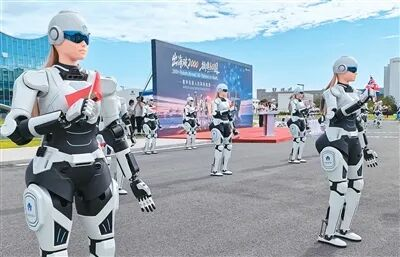
At Chery’s International Park in Wuhu, Anhui Province, dozens of robots stood holding flags from different countries, moving in perfect synchronization and with remarkable precision. Beside them, robotic dogs waited on the ground, their eyes glowing blue.
This was the scene at the global delivery ceremony for Chery’s Mojia Robotics. Shortly afterward, vehicles loaded with robots would head directly to Wuhu Port for export to Malaysia.
So, why are automakers getting into robotics?
The birth of Mojia Robotics was driven by a very practical problem faced by Chery’s overseas dealerships: staffing.
Employee turnover tends to fluctuate significantly with seasonal demand in overseas sales, while recruiting can be difficult. Even after employees are hired, multilingual training presents another challenge.
“We developed robots primarily to address real pain points and meet specific needs in real-world scenarios,” said Zhang Guibing, Executive Vice President of Chery Automobile and General Manager of Mojia Robotics.
In 2025, Mojia’s multilingual robot Moyin, capable of speaking 11 languages, officially began working at a Chery 4S dealership in Malaysia, taking on tasks including customer reception, product presentations, and standardized training.
“Today’s intelligent vehicle is essentially a mobile robot,” Zhang explained.
On the one hand, robots and intelligent vehicles share a high degree of technological commonality at the fundamental level, particularly in areas such as perception, planning, and control. Many technological modules, supply-chain resources, and after-sales service systems can therefore be transferred from the automotive sector to robotics.
On the other hand, automakers’ extensive global business operations provide robots with unique real-world testing environments, helping accelerate product development and iteration.
As competition in the automotive industry intensifies, more automakers are entering the robotics race. Leveraging the technological expertise and supply-chain advantages accumulated through vehicle manufacturing, they are accelerating their move into the field of embodied intelligence.
Mojia Robotics has already launched several products, including the humanoid robot Moyin, intelligent security robots, and the four-legged robotic dog Argos. Its products and services now cover more than 60 countries and regions, with a new companion robot also set to make its debut.
Meanwhile, other automakers, including BYD, XPeng, GAC Group, and Changan Automobile, are also increasing their investments in robotics.
A transformation from “four wheels” to “embodied intelligence” is now underway.
Going global is no longer simply about selling hardware overseas. It is becoming a global competition encompassing technology solutions, service systems, and localized operational capabilities.
In February 2025, Mojia Robotics entered Malaysia for the first time, applying its robots to automotive marketing and customer service.
“It was a completely unfamiliar market. We had no mature experience in localized operations, and customers did not yet understand what value robots could create,” said Zhang Shengshan, Vice President of Chery Automobile.
The journey was not easy, but the direction was clear: localization.
By adapting to overseas users’ habits, languages, cultures, and business processes, the company continuously optimized its robot functions while working with local partners to build service systems.
Step by step, it moved from simply “going out” to truly “going in.”
Starting from Malaysia, Mojia robots have since appeared on more stages around the world.
In March this year, the company showcased its robots at the 2026 Thailand International Automation and Manufacturing Exhibition, demonstrating the capabilities of Chinese robotics in industrial manufacturing and intelligent services.
In July, it launched its first AI Experience Center in Vietnam, promoting the commercial application of robots in automotive marketing and customer service.
The company has also obtained international certifications including EU CE certification and U.S. FCC certification, securing the necessary credentials to enter global markets.
“Going global with robots is not just a competition in product capabilities. It is a competition across the entire value chain, including R&D, manufacturing, supply chains, distribution channels, delivery, services, and localized operations,” Zhang Guibing said.
“Only by deeply integrating robots with local scenarios can they truly deliver greater value.”
So, which scenarios are best suited for robots?
Zhang identified two major areas.
The first is public services.
As large language models and public APIs continue to mature, robots’ ability to communicate through natural language is improving rapidly.
“Providing consultation and guided tours in museums, science and technology museums, or public service halls will soon become a reality,” Zhang said.
The second is specialized operations.
Take firefighting as an example. Smoke and extreme heat at fire scenes pose direct threats to firefighters.
“Robots and robotic dogs can leverage their advantages in vision and sensors to accurately locate the source of a fire and quickly carry out firefighting operations,” Zhang explained.
In environments that are particularly harsh or potentially dangerous, robots are likely to find practical applications even faster.
Source: Xinhua Auto
Disclaimer: Portions of the content and/or images in this article are sourced from enterprises or publicly available online resources. If any material infringes upon your copyright or other legal rights, please contact us for prompt removal.
 20
20
18
18
14
13
11
9
8
7
20
20
18
18
14
13
11
9
8
7
